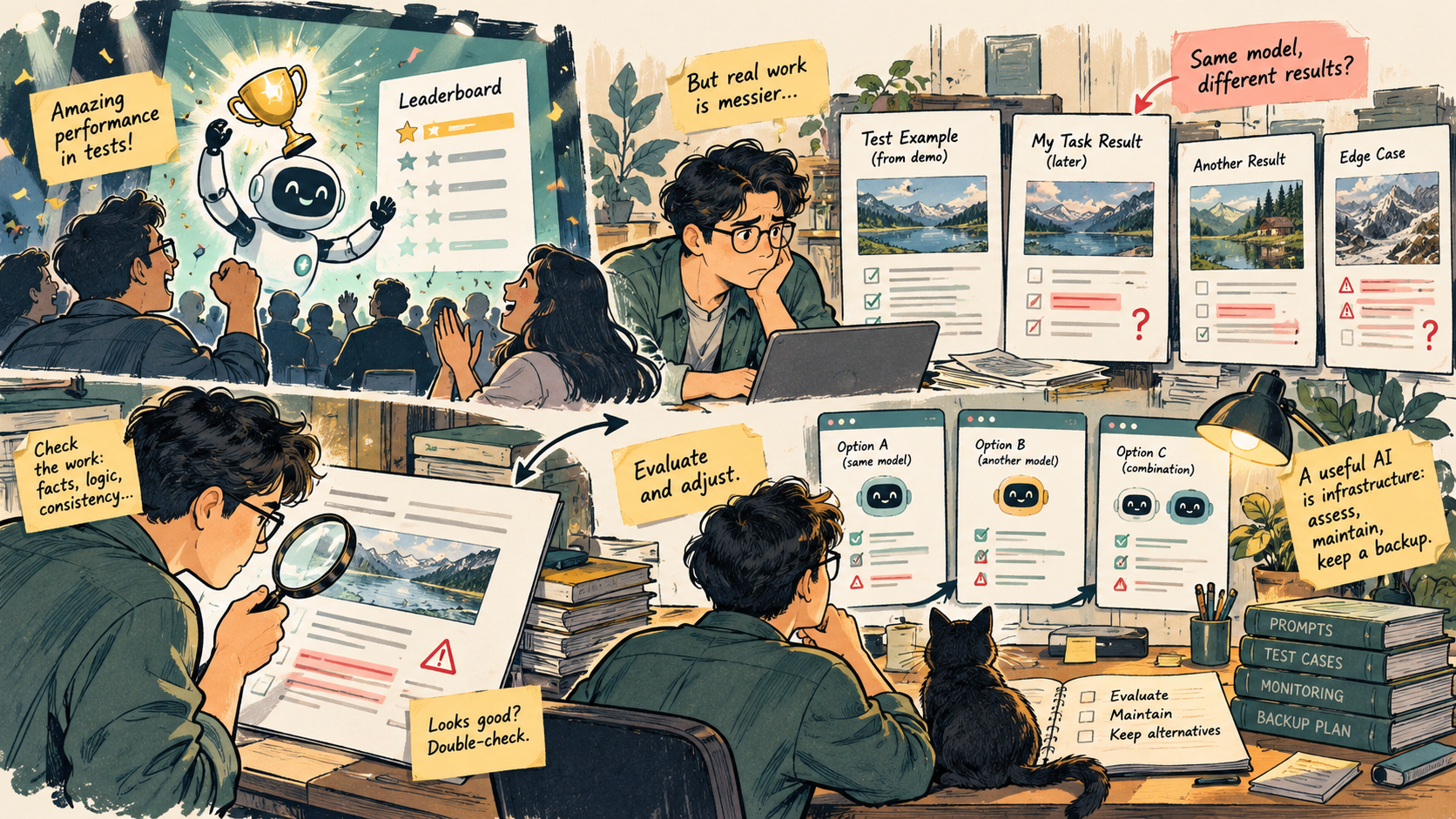
From Benchmark Scores to Reliable Personal AI
from impressive model performance to a working capability that needs ongoing evaluation and maintenance
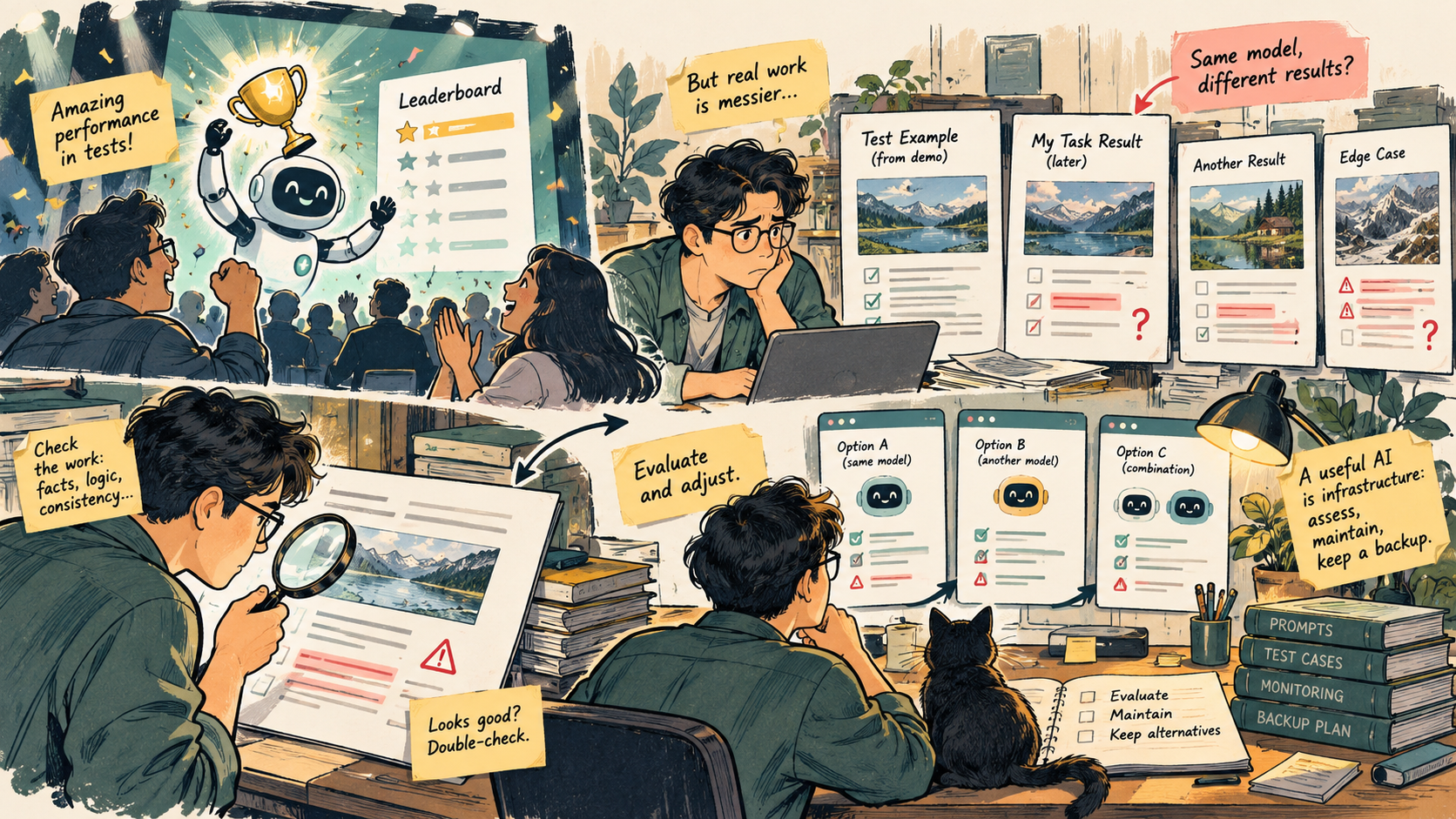
Lately, one question has become harder for me to ignore when using large language models: why does a model that feels impressive at launch not always feel equally reliable after I have used it for a while?
Another frustration is what I think of as “stubbornness.” When using GPT-6.1 Sol, I sometimes feel that it holds on to its own judgment too firmly. I want to understand whether I am simply uncomfortable with its interaction style, or whether there is a problem with how it responds to correction. For now, these are impressions from my own use, not conclusions from controlled comparisons.
Launch-day scores raise a related question for me: how much do they reflect transferable capability, and how much depends on optimization for popular benchmarks? If high scores do not consistently translate into useful work, should I keep a local model that is good enough for my needs and that I can control myself?
I later found public evaluations tracking similar changes, along with research examining the credibility of high scores and how models respond to challenges. That made the question broader than whether a particular model is useful: what, exactly, am I relying on, and how much control can I retain over it in the long run?
The Same Name Does Not Mean the Same Capability
I first want to distinguish two situations: a conversation gets longer and the results get worse; or I repeat the same task with the same context through the same model endpoint on different dates and get different results. I am more concerned with the latter. Context management matters, but it cannot automatically explain every regression across dates.
One account that changed how I understood this problem was Anthropic's September 2025 incident postmortem. According to the company, request-routing errors, runtime optimizations, and compiler problems affected the quality of some responses, and were addressed through fixes or rollbacks. In this incident, at least, the deterioration users experienced was traced to backend implementation issues, rather than dismissed as “you are not using the model properly.” Anthropic infrastructure postmortem
Another perspective comes from independent evaluator Margin Lab. Its report recorded several consecutive days of lower pass rates for Claude Code using Opus 4.7, coinciding with changes to the CLI version. The author suspected an issue in the agent harness, without establishing that the model itself had regressed. Because the client was also being updated, this was not an experiment with a fully frozen environment. Still, it examines exactly what concerns me: can the product combination I actually use keep completing the tasks it handled before? Margin Lab's ongoing evaluation report
For me, a failure at any layer can mean rework. Distinguishing causes should help me find a way forward; I do not think I must first prove that the weights changed before acknowledging the cost of a decline in service quality.
Nor do I want to collect only evidence for “it keeps getting worse.” When Chen and colleagues compared the March and June 2023 API versions of GPT-3.5 and GPT-4, they found improvements on some tasks and regressions on others. That reminds me to track changes on specific tasks, rather than assume that every change is downward. Study of changes in service behavior
These accounts shift my attention from a model's name to the capability delivered by the model and its operating environment together. Reasoning settings, system instructions, context handling, clients, tools, and external data can all affect results. Even identical inputs through the same endpoint do not guarantee unchanged backend versions or operating conditions. Establishing that performance changed, explaining why, and getting work moving again are three different problems. Not knowing what happened behind the scenes does not mean I have to wait for a root-cause diagnosis before stopping unproductive attempts and looking for an alternative.
The Gap Between High Scores and Real Work
This also makes me reconsider launch-day scores. Some gaps may not develop later at all: a model can perform well on a test while the work I expect it to handle has always been beyond what that score establishes.
Benchmark contamination is one reason to be cautious. Yang and colleagues showed that fine-tuning small models on rephrased test questions could produce high scores on the corresponding benchmarks, while simple text matching could miss the contamination. ConStat, a separate study by an ETH Zurich team, compares performance on a primary benchmark and related reference tests to identify benchmark gains that do not generalize. The studies take different approaches, but both make me ask: how much of the capability suggested by a score survives outside the familiar test? They are not grounds for accusing a particular provider of cheating; the suitability of the reference tests also matters to such a comparison. Rephrased-sample contamination study, ConStat study
My concern is not limited to whether the original questions leaked into training. Even without training directly on test questions, repeated optimization around popular question types and scoring rules may concentrate gains in those conditions. Specialized training for mathematics or programming is not inherently a problem. What I want to know is whether its benefits transfer to new tasks that were not part of training or selection.
There is also a simpler mismatch: the test may be measuring a different kind of work. Solving a clearly bounded programming problem is not the same as understanding requirements in an existing project, respecting the scope of a change, handling tool failures, and responding to feedback. I do not need to dismiss the first score to ask for a separate test of the second capability.
I would therefore examine contamination, overfitting to evaluations, and task mismatch separately. Each deserves attention, but none can replace an investigation of changes over time. Even if a model was trained with benchmarks in mind, that still does not explain why the same task became harder for it later.
Stubbornness or Reasonable Persistence?
Returning to my impression of “stubbornness,” the word captures frustration but is not precise enough. I want a model to accept a well-supported correction. If I am wrong, though, I also want it to tell me so instead of immediately agreeing.
One concrete experience came from a DDQN reinforcement learning project I was developing with help from gpt-6.1-sol. The goal was to train an agent to beat Hollow Knight. After repeated reviews with the same model and cross-reviews with Astra, most suggestions concerned implementation details. Yet the training was not showing the convergence I had hoped for, and its progress toward beating the game had not improved either.
I then turned to deepseek-v4.1-flash-1017 for a fresh review. After implementing and validating the core changes in DSH, I returned to Codex and used gpt-6.1-sol for further adjustments, retesting, and sampling. Only then did I see an improvement in convergence.
I would not attribute that improvement simply to switching models: the process also involved core changes, follow-up adjustments, and retesting. But the experience helped me understand another part of what feels like “stubbornness” to me. Sometimes a model is not explicitly refusing to change; the discussion just stays at the same level through round after round. In that situation, a fresh perspective on the core approach may be more useful than further polishing of implementation details.
What I really care about is whether evidence changes subsequent behavior. Does a model keep defending an incorrect judgment after receiving a verifiable correction? Does it acknowledge feedback, then perform the same incorrect action again? I want to judge whether the correction worked, not whether the model sounded agreeable.
Related research helped me draw that distinction more clearly. Dunlap and colleagues used two physics questions with constructed answers and rebuttals to examine persistence, sycophancy, and answer accuracy separately. In another study, Sharma and colleagues observed models changing initially correct answers into incorrect ones after users challenged them without supplying new evidence, across several question-answering tasks. These were not tests of GPT-6.1 Sol, but they remind me that “more willing to listen to me” is no substitute for the ability to correct mistakes. Study of responses to rebuttals, Sycophancy study
So, beyond whether a model gets something right the first time, I want to know whether it can recover after getting it wrong. If a failure actually comes from a broken tool, missing context, or a refusal to act, that needs to be handled on its own terms rather than filed under “stubbornness.”
Four Dimensions I Would Use to Judge Personal AI
Putting these questions together, I find four dimensions useful when deciding whether an AI is worth relying on over time. This is my way of organizing the problems. The dimensions can overlap; they are not a statistical classification of how often problems occur.
| Dimension | What I need to check | What not to confuse |
|---|---|---|
| Evaluation validity | Does benchmark performance transfer to my tasks? | A high score does not establish competence at every kind of work. |
| Delivery stability | Can I keep obtaining a capability I have already found useful? | The same model name does not mean the entire system is fixed. |
| Interactive error correction | Can mistakes be corrected with effective feedback? | Accepting evidence is not the same as unquestioning obedience. |
| Cost and control | Can I afford to use it, control where my data goes, and keep a fallback? | The price per token is not the total cost of completing a task. |
With that perspective, I care more about the money, time, and attention needed to complete an acceptable task. A cheaper generation may not be economical if it requires more rounds of correction and manual checking. A higher peak capability may not be a good sole dependency if I cannot keep accessing it.
Making Reliability Part of the Workflow
To put these judgments into practice, I would start with my own tasks and work records: define what counts as completion, check for changes, and prepare a way out when something fails.
First, I would choose a small set of real tasks and write down the acceptance criteria. For writing, I could check whether a translation preserves qualifications, whether edits stay within scope, and whether citations support the claims. For programming, I could check functionality, regressions, and changes to unrelated files. Anthropic's agent-evaluation guide emphasizes the final state of the environment; Google's evaluation documentation also recommends using data and criteria from a specific use case rather than selecting a model from public leaderboards alone. I want to borrow those principles, not build an evaluation platform for personal use. Agent evaluation guidance, Google's task-specific evaluation guidance
To observe changes over time, I would keep some tasks fixed, preserve their full inputs, source versions, and acceptance criteria, and repeat them through the same model endpoint on different dates. I would also keep new tasks that I do not use to tune prompts, so that my own test set does not become another familiar exam. The record should include successes, failures, and variability—not just the worst or best run.
Second, I would record the test date, model endpoint and version, reasoning settings, client, prompts, tools, and task environment together. Where the service allows it, I would choose an explicit version. Gemini, for example, distinguishes specific stable versions from latest aliases that change as new versions are released. That can reduce one source of variation, but it does not guarantee that the complete cloud environment remains unchanged or that an old version stays available indefinitely. Gemini version-naming documentation
I would also separate trying an upgrade from replacing my main setup. A candidate configuration can first complete comparable tasks in an isolated environment; only then would I decide whether to switch, while retaining an older configuration if it is still available. AWS's deployment guidance includes staged validation and rollback arrangements. For personal use, the point is to preserve options, not reproduce an enterprise process. A comparison must also avoid letting two agents both carry out real publishing, payments, or production-data changes. Model deployment and rollback guidance
Third, when correcting a model, I want to provide evidence that can be checked: tests and execution results for code, original sources for factual claims, and an agreed scope for writing changes. Another model can help review the result, but agreement between two models does not make something true.
If the result continues to fail acceptance checks and clear additional evidence does not move the task forward, I would stop that loop and first test whether another model or a person can take over. I would not wait for the backend cause to be established before acting. A separate conversation may help investigate the influence of old context, but it is not a general fix for service-quality regressions. Retries and spending also need limits, so that “persist until it is done” does not turn into consumption without progress.
Finally, a handoff should involve more than forwarding the entire conversation to another model. I would keep requirements, sources, tests, and intermediate results in documents and version control that I manage, while separating evidence-backed facts, untested hypotheses, and explanations that have been ruled out, along with the relevant sources or grounds for rejection. Failed attempts are worth recording too, but a failed execution does not by itself falsify the underlying hypothesis. What I want to avoid is a summary turning a guess into a fact, allowing a new model to continue from the same mistaken premise. Prompts and skills can carry instructions; important boundaries still need tool permissions, checks, and human confirmation.
What Local Deployment Can Offer
This is also why I am considering local deployment. For a model that can run locally, I can retain the weights, quantized version, runtime, and configuration, and decide when to replace them. That control is what first appeals to me—not an assumption that local models are inherently smarter than cloud models.
Privacy is another important consideration. If inference and document processing both happen locally, sensitive content does not need to accompany inference requests to a cloud service. Tools already support this kind of offline workflow. I would still need to check whether remote tools, uploaded logs, or cloud synchronization send data elsewhere, and manage local access permissions. A local model does not automatically make the whole data path secure. LM Studio offline documentation, Hugging Face offline and telemetry controls
The model still has to be useful enough. If a model-and-hardware combination can reliably handle my core tasks, with suitable speed, context capacity, and tool capabilities, keeping it may matter more than chasing each new top score. Keeping an inadequate capability consistently available does not solve the work problem.
Nor can I expect a change in deployment location to remove contamination, errors, or correction problems already present in a model. Fixed weights do not mean identical outputs every time: sampling, the runtime environment, and external tools can still introduce changes. Quantization and configuration updates also need to be tested again. Local deployment more directly changes who controls those changes, while making me responsible for maintenance.
When comparing costs, I would include hardware depreciation, electricity, maintenance, waiting, and rework—not just whether I still pay for each token. Existing equipment, actual usage, and whether a cloud subscription already meets my needs all affect the result. “More controllable” and “cheaper” are two separate questions for me.
I would consider giving local or lower-cost models tasks they have already been shown to handle, while reserving harder tasks for stronger cloud services. But keeping another route has routing, review, and maintenance costs of its own. The combination only makes sense if the risks and rework it avoids justify that investment.
From Choosing a Model to Maintaining a Capability
Returning to my initial frustration, I do not want to attribute every disappointment to “the model has been dumbed down,” nor use “you are not using it correctly” to dismiss genuine quality regressions.
A launch-day score tells me what was possible under particular conditions. Once I bring a model into my own work, I also need to know whether it can handle my tasks, whether changes in its performance can be detected, whether mistakes can be corrected, and whether I have a fallback when it fails.
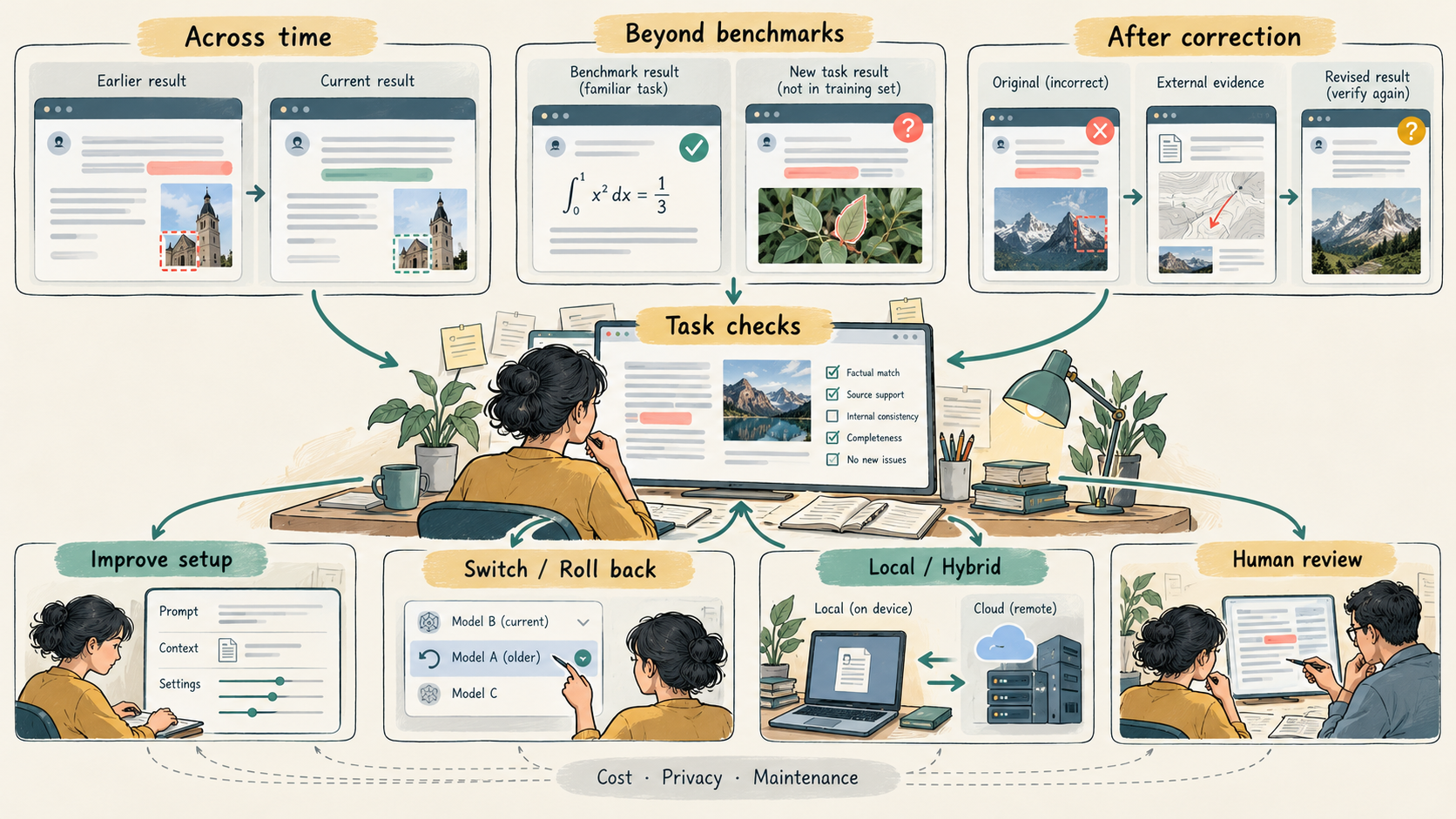
Figure 1. Real-task checks inform setup changes, switching or rollback, local or hybrid resources, and human review or handoff. Every path requires renewed validation and trade-offs around cost, privacy, and maintenance.
Note: The image’s phrase “not in training set” here means new tasks are held out from my own prompt tuning, not known to be absent from model training data.
I therefore prefer to think of personal AI as a working capability that needs ongoing maintenance, rather than a long-term bet on one model. Cloud services can offer capabilities that are difficult to deploy myself; local deployment can offer more direct version control. Both need to be tested on real tasks.
What I ultimately want to retain is not just the name of a model that once seemed very smart. It is a way of working that I have tested for myself, whose limits I understand, and that I can recover or replace.
References
- Anthropic. A postmortem of three recent issues. 2025-09-17.
- Margin Lab. Claude Code degraded for the week before Opus 4.8's release. 2026-05-29.
- Chen, L., Zaharia, M., & Zou, J. How Is ChatGPT's Behavior Changing over Time?. arXiv:2307.09009, v3, 2023-10-31.
- Yang, S., et al. Rethinking Benchmark and Contamination for Language Models with Rephrased Samples. arXiv:2311.04850, v2, 2023-11-11.
- Dunlap, J. C., Parent, A.-S., & Widenhorn, R. Feedback indices to evaluate LLM responses to rebuttals for multiple choice type questions. Discover Artificial Intelligence, 2026-06-23.
- Anthropic. Demystifying evals for AI agents. 2026-01-09.
- Google. Gemini API Models, “Model version name patterns.” Accessed 2026-10-26.
- AWS. Continuous deployment, MLOps checklist. Accessed 2026-10-26.
- Dekoninck, J., Müller, M. N., & Vechev, M. ConStat: Performance-Based Contamination Detection in Large Language Models. NeurIPS 2024.
- Sharma, M., et al. Towards Understanding Sycophancy in Language Models. arXiv:2310.13548. First submitted 2023-10-20; the v4 used here was revised on 2025-05-10.
- Google Cloud. Gen AI evaluation service overview. Accessed 2026-10-26.
- LM Studio. Offline Operation. Accessed 2026-10-26.
- Hugging Face. Environment variables,
HF_HUB_OFFLINEandHF_HUB_DISABLE_TELEMETRY. Accessed 2026-10-26.
AI Assistance
The topic, experiences, and central questions in this essay are mine. AI tools assisted with research, structural discussions, drafting, source checks, editing, translation, and image generation. I am responsible for the views and final content in this article. Both illustrations were generated with AI and selected by me.
Comments
Join the discussionNo comments yet. Be the first to comment.